Why Everyone Needs a Website (2025-2026 Update)
Some people still wonder if websites are necessary. It may be hard to believe, but a small number of business owners still don’t see the point of having one.
Some think their business has reached a natural plateau and that nothing more can be done. Others believe the benefits simply won’t justify the cost. Here’s why that thinking no longer holds up in 2026.
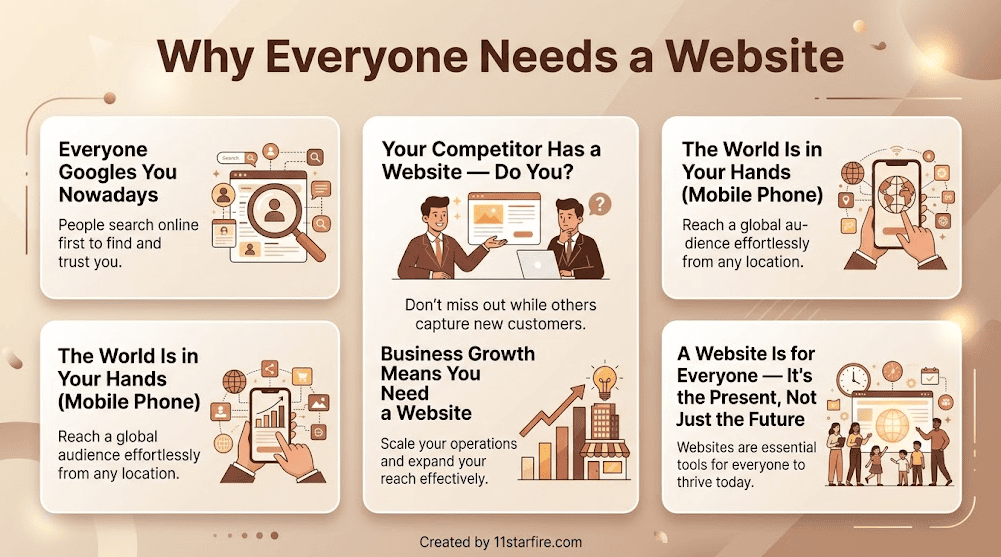
1. Everyone Googles You Nowadays
Yup, that’s still true — and more than ever. Around 99% of consumers use the internet to discover local businesses, with a large share searching online every single day. Increasingly, buying decisions now begin not just with a Google search, but with AI overviews and voice assistants too. If your business isn’t listed properly online, or worse, has no website at all, there’s a strong chance the customer searching will simply choose a competitor who does.
2. Your Competitor Has a Website — Do You?
There’s always competition, and today the gap is wider than ever. Around 83% of small businesses now have a website, up sharply from just 64% in 2018 — meaning businesses without one are now the exception, not the norm. No matter how good your product or service is, if a competitor shows up in search results and you don’t, they get the customer’s attention first. Roughly 81% of consumers research a business online before ever using its services — without a website, you’re invisible during that critical research stage.
3. The World Is in Your Hands (Mobile Phone)
Mobile isn’t just important anymore — it’s dominant. Mobile devices now account for more than half of all global web traffic, and a majority of consumers say they’re more likely to buy from a business with a mobile-friendly website. The stakes are even higher on speed: most mobile users abandon a website that takes longer than 3 seconds to load. If your site isn’t fast and mobile-optimized, you’re likely losing customers before they even see what you offer.
4. Business Growth Means You Need a Website
A website gives you direct access to a massive, active online audience — most of whom would never have discovered you otherwise. It’s no longer just a marketing brochure either; today’s websites function as real operational tools, supporting inquiries, bookings, and even direct sales. Businesses that maintain both a website and a social media presence consistently generate significantly more revenue than those relying on social media alone — proof that a website isn’t a replacement for social media, but an essential complement to it.
5. A Website Is for Everyone — It’s the Present, Not Just the Future
Like it or not, a website is now genuinely relevant for almost everyone: students, freelancers, small business owners, agents, side-hustlers, and full-time employees building a personal brand. The industry, the market, and the world have already changed — this isn’t a future prediction anymore, it’s the current reality. Businesses that haven’t adapted yet aren’t just falling behind on trends; they’re falling behind actual customer behavior happening right now.
A website is no longer optional in 2026 — it’s a fundamental part of being findable, credible, and competitive. Whether it’s showing up in a Google search, converting a mobile visitor in under three seconds, or simply being where 8 in 10 consumers already look before making a decision, the businesses without a website aren’t just missing an opportunity — they’re increasingly invisible to the customers actively searching for them.